


 Dec 22, 2025
 3 min read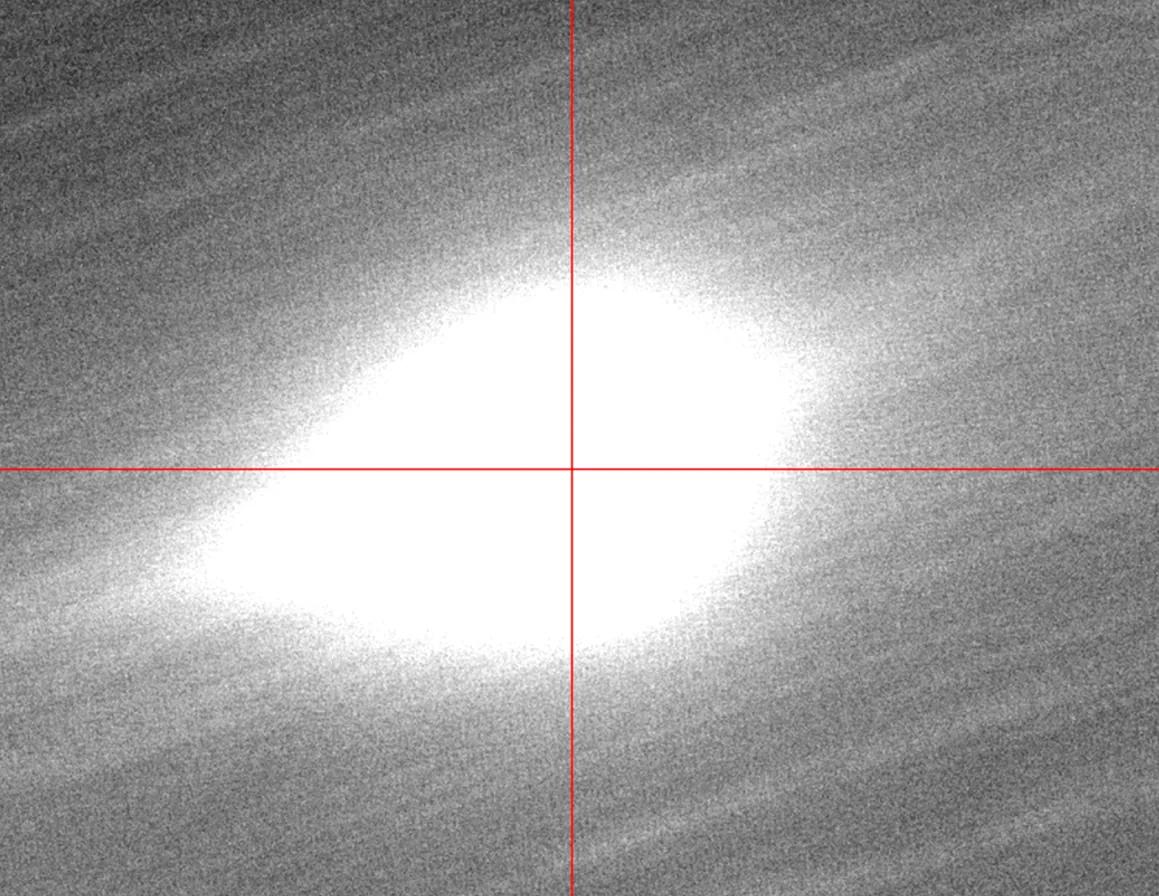
The famous interstellar comet 3I/ATLAS was 270 million kilometers from Earth on Friday, its closest point during its current journey...
The famous interstellar comet 3I/ATLAS was located 270 million kilometers from Earth on Friday, the closest point it will be during its journey through our solar system.A journey that has aroused much anticipation and is being followed by astronomers around the world.To capture this approach, several telescopes at the Instituto de Astrofísica de Canarias (IAC) pointed their instruments at the comet during the night from Thursday to Friday, and the result is the photo that illustrates this article.
This is a compilation of 167 images taken by the Robotic Survey Telescope (TST) at the El Teide Observatory between 2:07 a.m. and 6:28 a.m. on Friday.This telescope, with its first 1-meter mirror, allows us to detect fast and faint objects such as this interstellar comet, which was discovered on July 1 by the Chilean telescope and is the third object from another planetary system to be discovered.
As IAC researcher Javier Licandro explains in a telephone interview, they also use the Teide observatory's two-meter TTT telescope to follow 3I/ATLAS: "We started observing it in the summer, stopped when it was not visible because it was very close to the Sun, at the end of October, and resumed observations because we monitor the weather every week. For example, we had storms."
Fortunately, on the night of these interstellar visitors' closest approach to Earth, the weather didn't stop them from photographing and studying "what may be the oldest comet we've ever seen."
From the el roque de los muchachos observatory on the island of La Palma, which also belonged to the Internahopeli Islands of the Cange Instruments, they observe the intersteler Julia de leon, which is part of the ED EDDPTOLERERAL NELIVERS ANDObserve the instrument.Spectrascopy at the same time, as usual is it that if you get one or another thing, "he says.
"The study of this comet is very important because it comes from outside our solar system and gives us direct information about other stars and other planetary systems, so it is of great interest to us. All objects that escape from other stars are a gift to scientists," de León said.
However, the observations did not cause a big surprise: "We see a normal evolution of the object, which is within the expected parameters for a comet, bright, but not too much and shining. The brightness did not suddenly increase, change direction or behave strangely. Harvard University scientist Avi Loeb learned about the nature of this object".
As this IAC astronomer explained, comets are like giant snowballs and can contain pockets of more volatile matter."Sometimes they change when the heat arrives and suffer small explosions, but this did not happen, there was no significant explosion. On the other hand, the cores of these bodies are very weak and can sometimes break. 240P, a very interesting comet orbiting the Sun, but this was not the case with 3I/ATLAS. The difference is that it has more CO2 and the isotopic ratio of some molecules is a little different from that of the stars in our solar system, which is expected because it was formed in another star, which formedin another region of the galaxy, where the composition of the elements is not the same as the region where the Sun formed, says Licardro.
As Julia de León explains, water ice is the main substance that drives activity in comets in the solar system, but in 3I/ATLAS they saw a greater proportion of carbon dioxide ice than water ice."In your case, carbon dioxide ice is the main driver of cometary activity. It could be common in the system it came from, or it could be something unusual, because we've seen it in comets in our solar system. The same thing happened with the interstellar comet 2I/Borisov, the main cometary activity is caused by carbon monoxide, not water ice," he said.
Altitude of carbon dioxide 3i / atlas, because it has not approached since the day, "It approached its star during the day", this Comet we see, the animation is lost because it is disturbed, "According to Licander.
"This has implications because, for example, it helps us estimate how far away it formed from its star, how hot its star was or what type of star it is. And we can estimate how long ago this comet was affected by the heat of a star without this ice," says Julia de Leon.
According to Licandro, the result of these observations is that these comets that form around other stars are very similar in composition and physics to comets that form in our own solar system.This tells us that the process of planet formation in other stars must be very similar, or that our solar system formed like other planetary systems.” According to the astronomer, “the expected result.The surprise would be the opposite."
He explains that it is very difficult to estimate its size because they cannot see the nucleus: "As the American astronomer Fred Whipple said in the middle of the last century, a comet is a dirty snowball because it contains dust and other elements in addition to water ice. When it approaches a star, our Sun is heated from rock to dense gas. In a giant cloud of gas and dust, it is difficult for us to see the core," he notes.It does. The best estimate they have is still the one made using data from the Hubble Space Telescope, which shows it to be between 220 meters and 2 kilometers tall.
There are still a few months left to continue studying it, although as Julia de León elaborates, "in April it will only be visible with telescopes between eight and ten meters, and from June it will no longer be visible on Earth."